Where you look decides how many things you can track
Some people can follow six moving things at once and others lose track at three. The usual story blames a limited mind. A model that borrows each person's eye movements tells a simpler one.
Ever wondered why we sometimes cannot keep track of things, even when we are trying hard? Watch a street magician shuffle three cups and try to follow the one with the ball. Most people lose it. Now imagine following four cups, or six. Intuitively, it might seem that the mind has only so much room to keep track of several things at once, and that is why it feels so effortful. There is research that speaks to this idea. Studies of visual working memory suggest we can hold only a few objects in mind at a time, and that the more we try to hold, the less clearly we hold each one.1 But we do not have a good answer on what these resources are, or what that effort means. My first paper, written with Jonathan Flombaum at Johns Hopkins, argued for a simpler and more concrete answer: a lot of the difference between good and bad trackers comes down to where they point their eyes, and when.

Psychological & Brain Sciences, Johns Hopkins
The puzzle
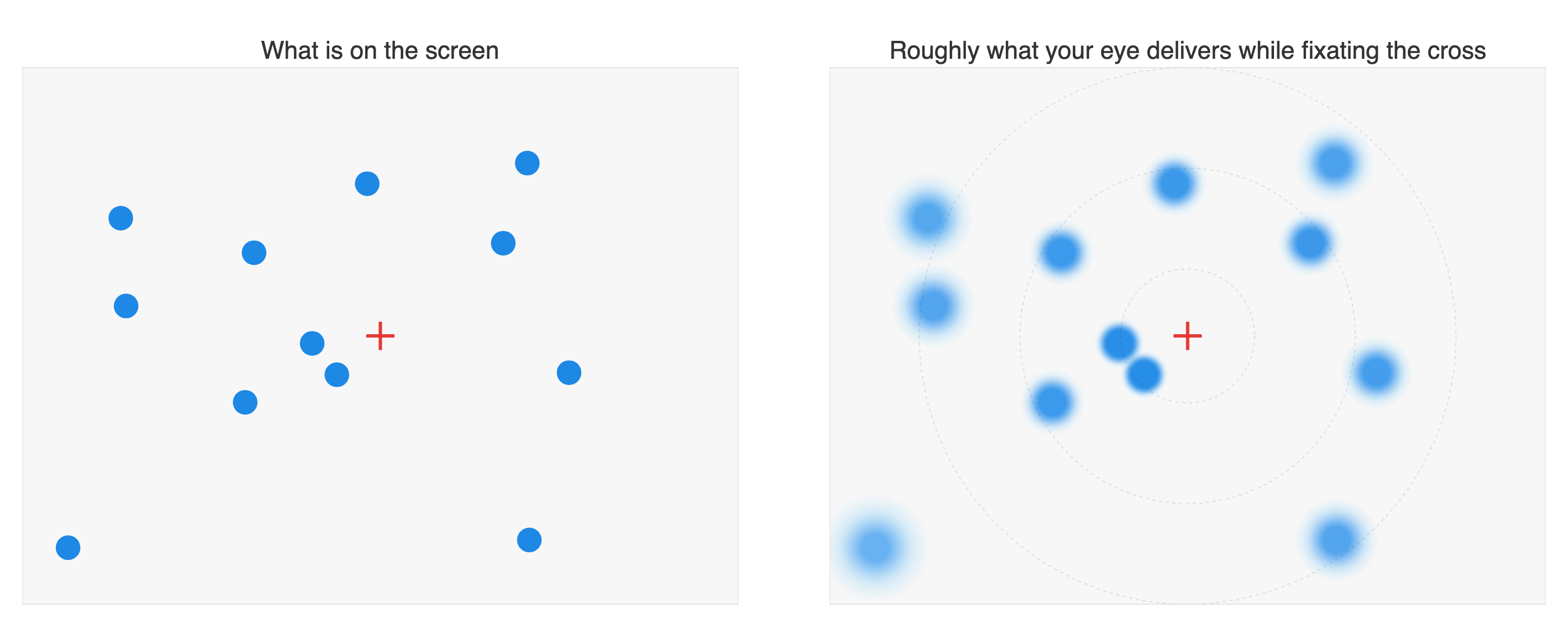
The human eye is not a camera. Only a tiny patch at the center of your gaze, the fovea, sees sharply. Everything else is blurry, and it gets blurrier the farther it is from where you are looking. This is why you fixate a word to read it and fixate a face to recognize it. For most of what we do, the rule "look at the thing you care about" works.
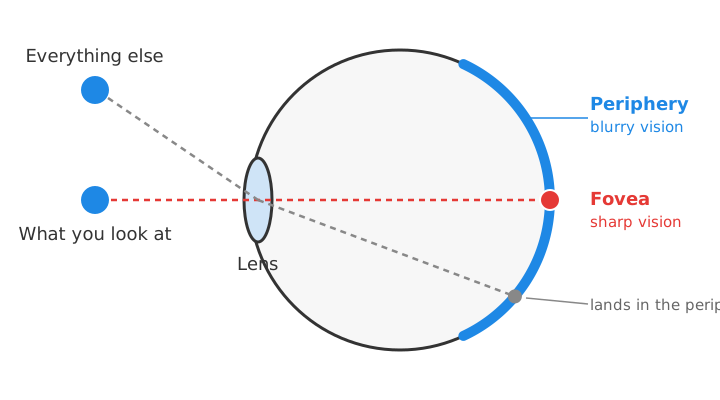
But what if you care about several things at once, and they are all moving?
Psychologists study this with a task called multiple object tracking. A handful of identical dots appear on a screen. A few of them flash to mark them as targets. Then every dot turns the same color and they all drift around for ten seconds, bouncing off each other and off the walls. At the end you click on the dots you think were the targets.
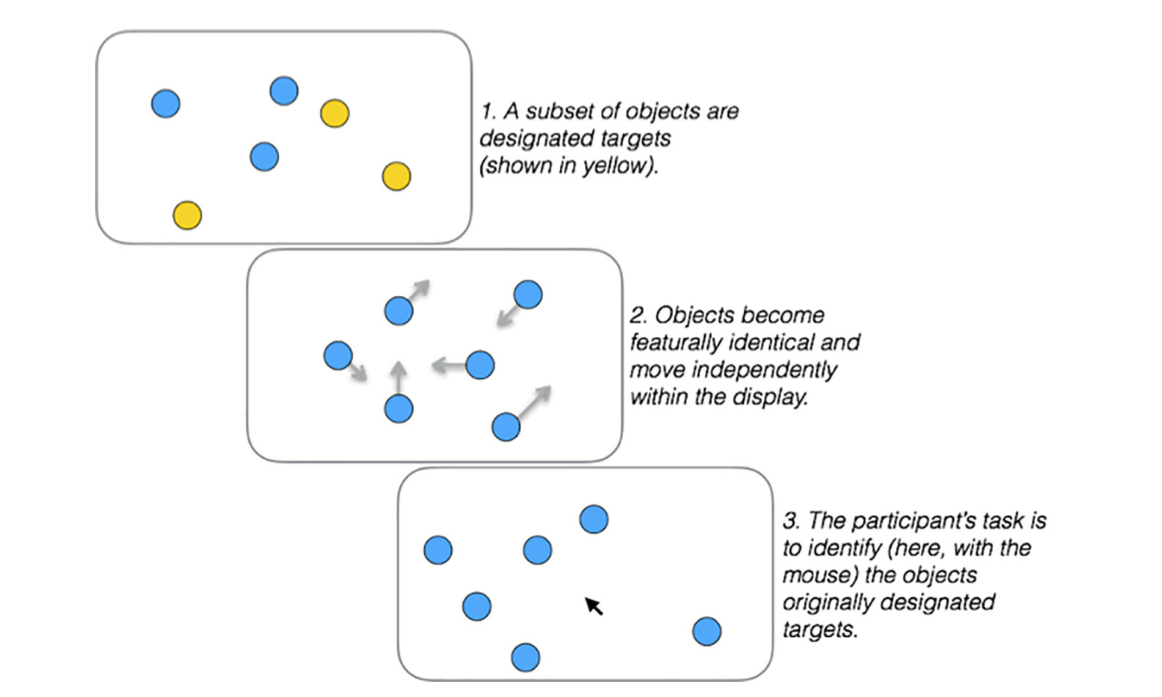
Almost everyone can manage three or four. Almost nobody can manage seven or eight. And some people are reliably much better at it than others. For decades, both facts were explained in the same spirit: some internal budget of attention or memory that runs out.
Where do people actually look?
Here is the thing about tracking several moving dots. You cannot look at all of them. Looking at one means the others fall into your blurry periphery. So the best place to look is often nowhere in particular: an empty patch of screen that keeps all the targets reasonably close to the center of your vision. Earlier studies had noticed that people do sometimes look at the "centroid," the average position of the targets.2
We recorded the eye movements of 50 people while they did 120 tracking trials each, with three to eight targets moving at four different speeds. Every participant saw exactly the same trials, which matters for what comes later.
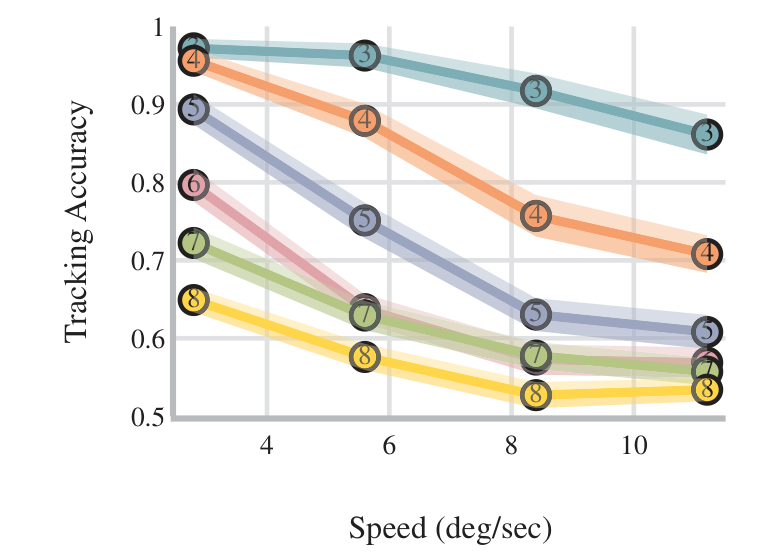
The first thing we confirmed is that tracking skill is a stable trait. People who did well on slow trials also did well on fast ones, and people who did well with few targets also did well with many. Whatever separates good trackers from poor ones is consistent.
The second thing surprised us. When we looked at where people fixated, fewer than half of their fixations landed on either a target or the centroid. Most of the time people were looking at empty space that was not the centroid.
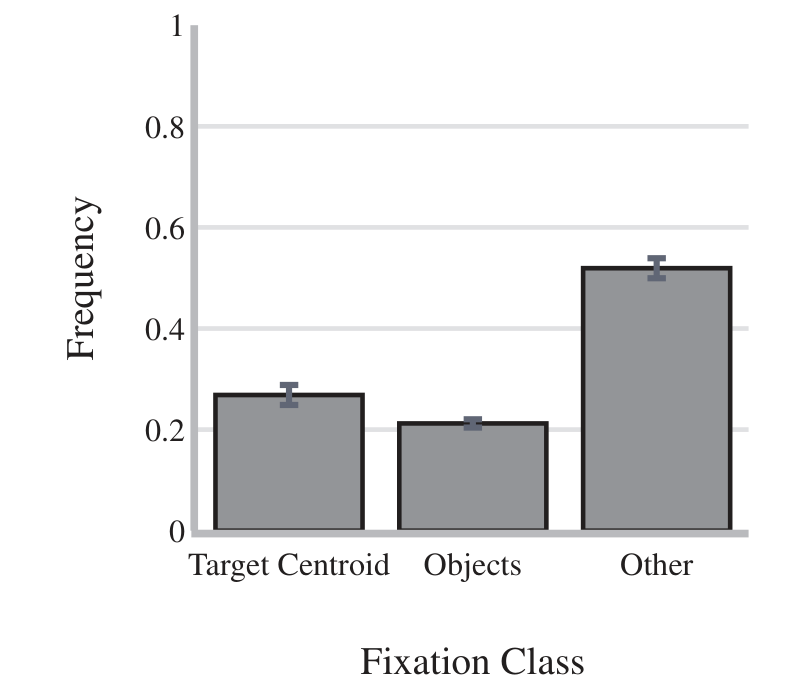
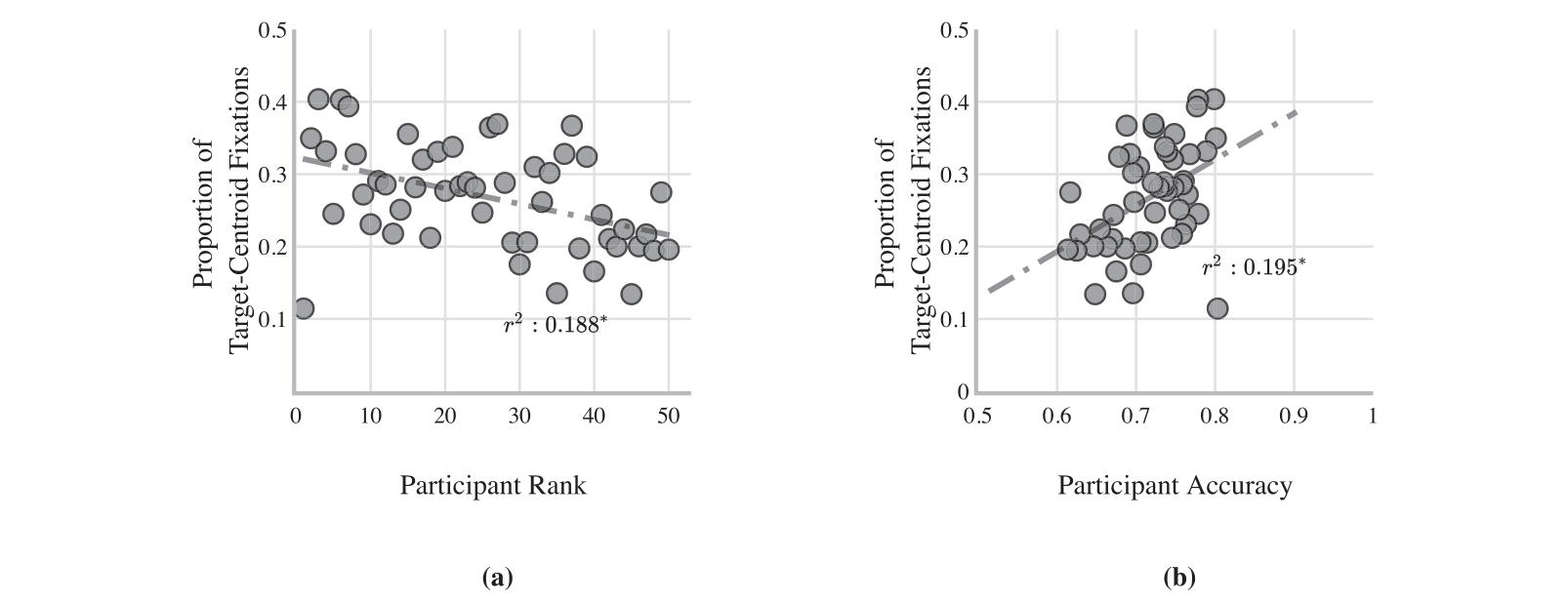
Good trackers did spend a bit more time near the centroid than poor trackers, but that explained only about a fifth of the difference between people. How much people moved their eyes around explained about the same. Simple labels like "looks at the centroid" or "looks at the objects" clearly were not capturing what skilled trackers were doing.
More details about the experiment
Fifty Johns Hopkins undergraduates each did 120 trials. We built the trials ahead of time so everyone saw the same ones, in a different random order. There were six target counts (3 to 8, always with an equal number of distractors) and four speeds (2.8 to 11.2 degrees of visual angle per second). Each trial moved for 10 seconds. An EyeLink 1000 eye tracker recorded gaze, which we lined up with the screen's 60 frames per second, giving 600 gaze positions per trial.
To check that skill was stable, we split each person's trials in two ways. Accuracy on slow trials predicted accuracy on fast trials (r² = 0.78), and accuracy with few targets predicted accuracy with many (r² = 0.57). We counted a fixation as "on the centroid" or "on an object" only if it fell within 4 degrees of one. Fewer than half of fixations qualified, and fewer than a fifth with a stricter 2 degree rule. Time spent on the centroid explained 19% of the differences in rank between people, and how widely the eyes wandered explained 20%.
A model that borrows your eyes
Instead of trying to guess what strategy each person was using, we built a computer model that does the tracking task itself, and then handed it each participant's real eye movements.
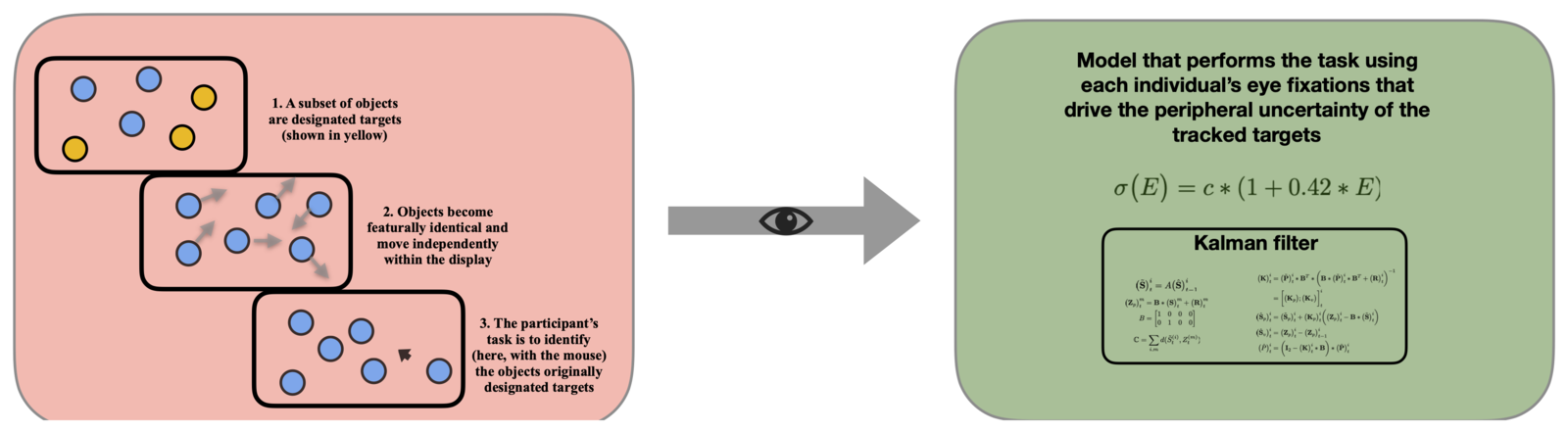
The model is deliberately simple. Twenty times a second it receives a noisy snapshot of where every dot is. It keeps a running estimate of each target's position and velocity, predicts where the target will be next, and then matches the new snapshot to its predictions. The dots are identical, so it has to work out which observation belongs to which target, and it does that by finding the assignment that moves everything the least. This is the same kind of math that tracks aircraft on radar.
The one twist is the noise. A dot that is close to the participant's current fixation gives the model a precise observation. A dot far out in the periphery gives a blurry one. So when the model plays a trial "as" participant 17, it sees what participant 17's eyes made available at every moment, and nothing else.
Crucially, we did not tune anything to fit the data. The noise formula and the sampling rate came from earlier vision research and were the same for everyone. The model had no attention limit, no memory limit, and no idea who was a good tracker. The only thing that changed from one simulated participant to the next was the sequence of fixations.
More details about the implementation
Each target gets its own Kalman filter, a standard tool for tracking something you can only observe noisily. The filter stores a best guess of the target's position and speed, assumes it keeps moving in a straight line, and corrects that guess whenever a new observation arrives. Observations arrive 20 times a second, a rate borrowed from studies of how quickly attention samples the world.
Each observation is the true position plus random error. The size of that error grows with distance from the fixation: the standard deviation is 0.08 × (1 + 0.42 × E), where E is how many degrees away from the fixation the object is. That formula comes from earlier measurements of how vision degrades in the periphery (Carrasco et al., 1995; Rovamo & Virsu, 1979).
Because the dots are identical, the model gets a bag of unlabeled positions each time. It matches them to its predicted targets by finding the pairing with the smallest total distance, using a standard assignment algorithm. We ran every trial 100 times per participant with fresh random noise and averaged the results. We did not fit any parameter to any person.
What the model told us
Given only where people looked, the model predicted how well each of them tracked. It picked out the strong trackers from the weak ones, and it ranked the 50 participants in roughly the right order. On individual trials the fit was even tighter: trials that were hard for people were hard for the model, and trials that were easy were easy for both.
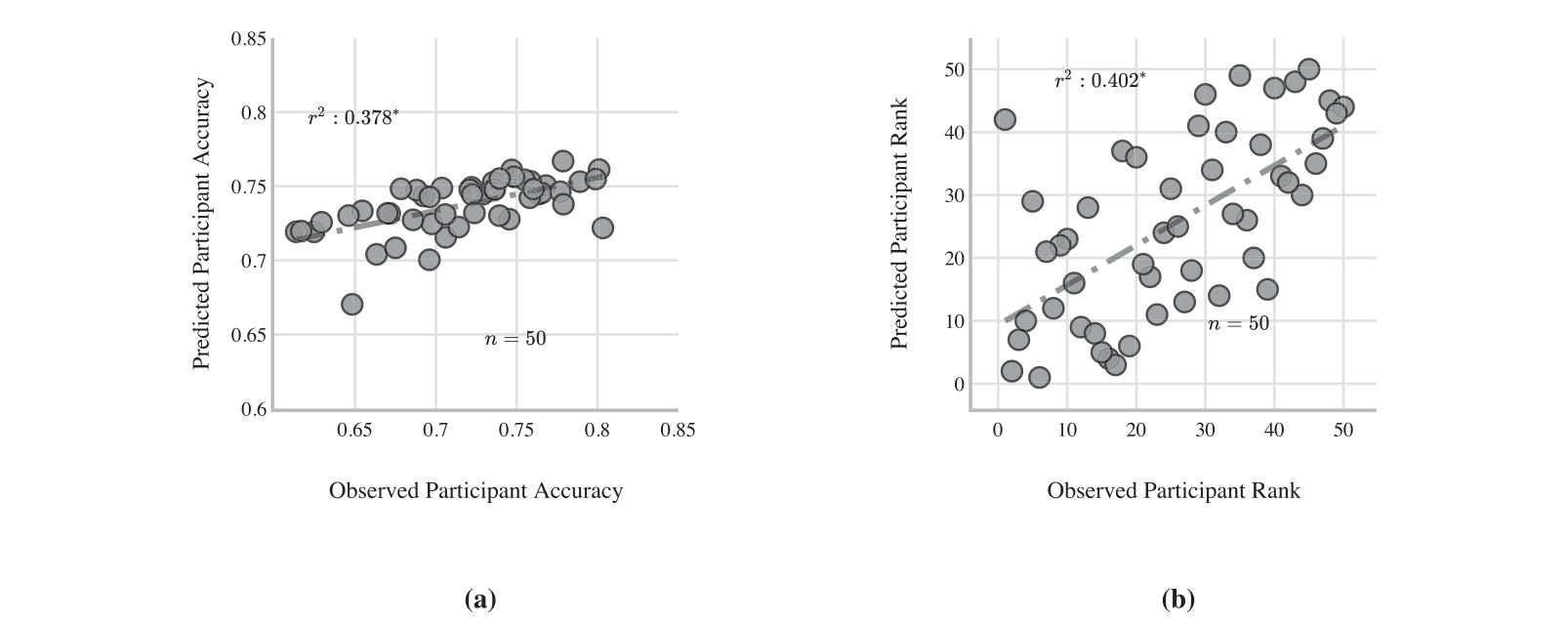
We then ran a control that I still find satisfying. We fed the model each person's fixations in reverse order, so it saw the same places but at the wrong times. The predictions collapsed to a fraction of their former strength. Being a good tracker is not just about picking good places to look. It is about looking at the right place at the right moment, as targets drift toward distractors and the risk of confusing them rises and falls.
More details about the results
The model's predictions explained 38% of the differences in accuracy between people and 40% of the differences in their rank, both well beyond chance. Trial by trial the match was much tighter: 82% across all 6,000 person-by-trial combinations, and 83% across the 120 trials once averaged over people. When we reversed the order of each person's fixations, the model explained only about 20% of the differences between people. The individual-level numbers are roughly half of how consistent people were with themselves, so there is room for a better model to explain more.
Limits that nobody built in
This is the part of the paper I like most. The model had no capacity limit. It could represent eight targets at once without complaint. Yet look at what it did when we counted how many targets it got right on each trial.
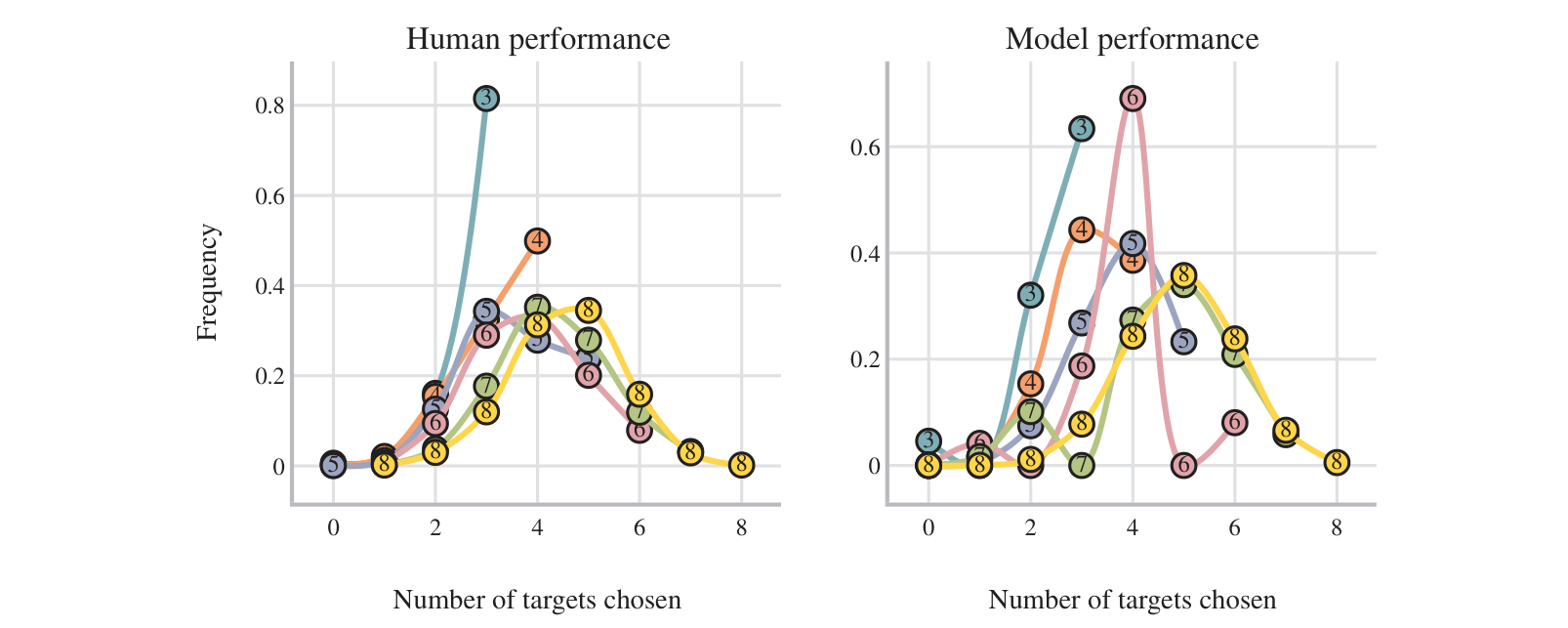
People mostly got about four targets right no matter how many they were asked to track, and essentially never got seven or eight. So did the model. Nobody programmed a limit of four into it. The limit emerged on its own, from the ordinary uncertainty of blurry, sampled input and the growing chance of mixing up identical objects as they crowd together. Some of what looks like a hard cap on the mind turns out to be the ordinary consequence of an eye that sees clearly only in one place.
Why this matters
That reframes what it means to be bad at tracking. Saying someone "has less attention" is a description dressed up as an explanation. Saying they looked in the wrong places at the wrong times is something you can measure, model, and in principle train.
The model still had room to improve. It outperformed humans overall, because it never gives up on a target or guesses, and real people do both. It also captured only about half of the reliable individual differences. But it did that with zero free parameters, which convinced me that the eyes are carrying a large part of the story.
Upadhyayula & Flombaum (2020). A model that adopts human fixations explains individual differences in multiple object tracking. Cognition. Paper · Code · Data
This work in the research section: Why can we only track a few things at once?
Figure credits. Shell game animation via GIPHY. Figures 1, 4, 6, 7, 10, and 11 are reproduced from Upadhyayula & Flombaum (2020), Cognition, doi:10.1016/j.cognition.2020.104418. The eye diagram, the blur illustration, the model schematic, and the model demo animation are by the author. The headshot is the faculty portrait from the Johns Hopkins Psychological & Brain Sciences directory.
-
If you want to read more: Zhang & Luck (2008), Discrete fixed-resolution representations in visual working memory, Nature, doi:10.1038/nature06860; and Alvarez & Cavanagh (2004), The capacity of visual short-term memory is set both by visual information load and by number of objects, Psychological Science, doi:10.1111/j.0963-7214.2004.01502006.x. ↩
-
Fehd & Seiffert (2008), Eye movements during multiple object tracking: Where do participants look?, Cognition, doi:10.1016/j.cognition.2007.11.008; Fehd & Seiffert (2010), Looking at the center of the targets helps multiple object tracking, Journal of Vision, doi:10.1167/10.4.19; and Zelinsky & Neider (2008), An eye movement analysis of multiple object tracking in a realistic environment, Visual Cognition, doi:10.1080/13506280802000752. ↩