Skip to content

How do we experience the passage of time?

Time is said to expand during novel or frightening events โ€” tachypsychia. We asked whether it really does. It does not: perception of duration stays put, and it is memory for the event that is distorted. What feels like time stretching is a trick played after the fact.
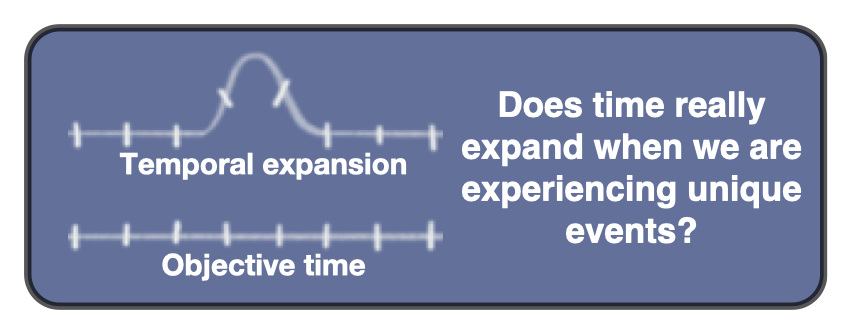
Two timelines: an objective time axis with evenly spaced ticks, and above it a temporal expansion axis whose ticks spread apart around a bump, beside the question of whether time really expands during unique events
The question: does time really expand during unique events, or only seem to?
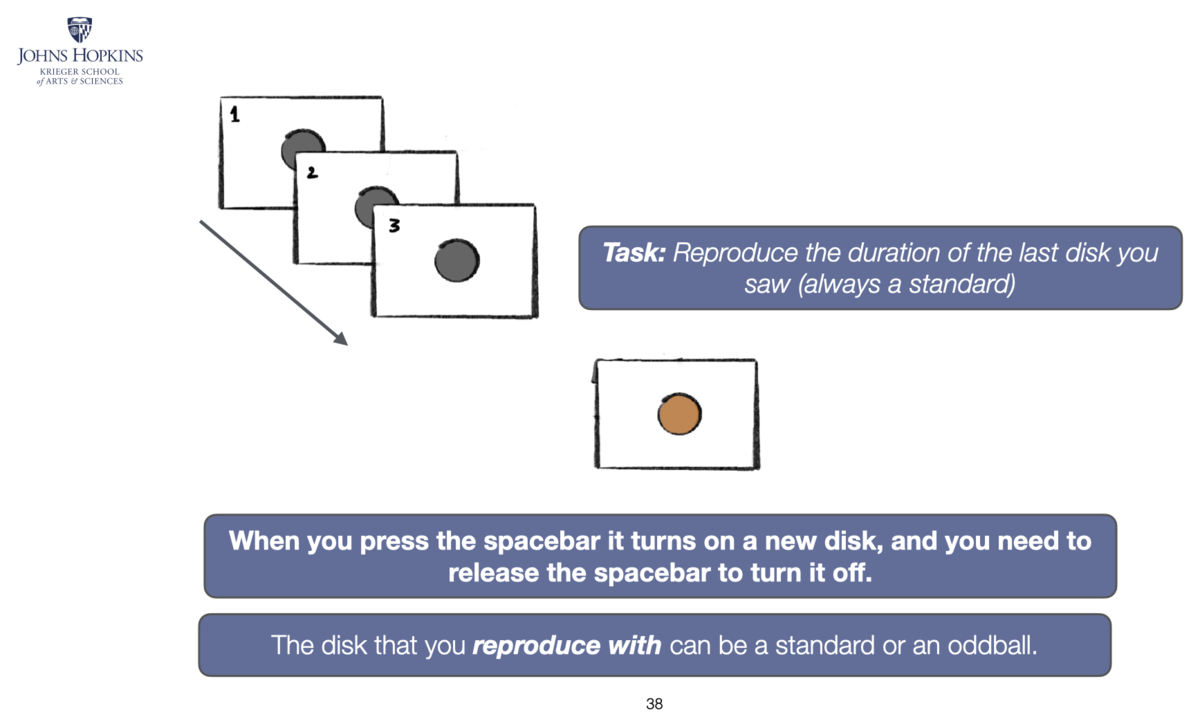
Task schematic: a sequence of numbered displays each showing a grey disk, followed by a reproduction display with an orange disk. Participants hold the spacebar to reproduce the duration of the last disk they saw
The task: reproduce the duration of the last disk by holding the spacebar. The disk you reproduce with can be a standard or an oddball.
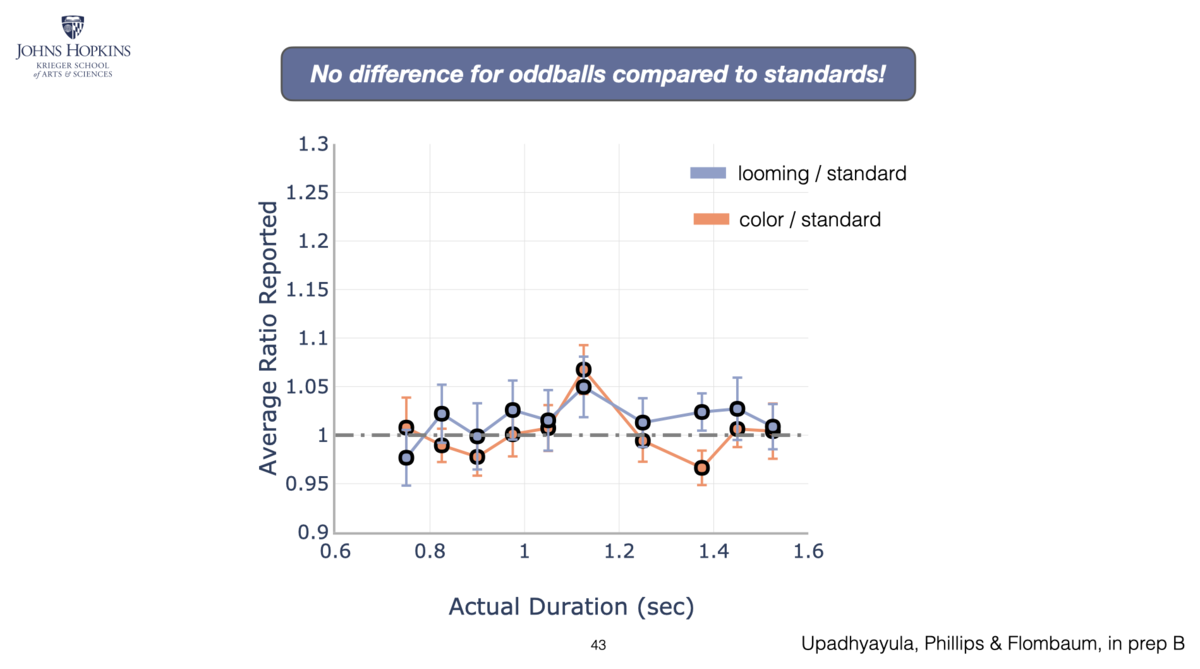
Average ratio reported plotted against actual duration from 0.75 to 1.5 seconds, for looming and colour oddballs relative to standards. Both series sit on the ratio-of-one line across the range
The result: no difference for oddballs compared with standards โ€” reproduced durations sit on the line of veridical performance.

Upadhyayula, Phillips & Flombaum (in preparation). Presented at Vision Sciences Society 2020. Poster talk ยท Try the experiments


Back to How is information perceived?