Is grammar a property of language, or of thought?
Language is not the only way to carry a complex thought. A handful of pictures can do it too, and readers agree on how those pictures group into a story. When a parser built for sentences is handed a grammar for pictures, it groups them the same way. Grammar may be a property of how we think, not just of what we say.
A visual narrative is a story told in pictures. A few panels, no words, and you follow a complex thought from beginning to end: who wanted what, what went wrong, how it ended. We have been doing this for a very long time. The animals on the cave walls at Lascaux and Chauvet are not a catalogue. They are arranged, and some of them seem to be telling a story, tens of thousands of years before anyone wrote anything down. At the other end of the scale sits language, the most sophisticated medium we have for conveying thought, and its defining feature is that it is richly organized. Words do not pile up. They nest into phrases and clauses according to grammatical rules, and that structure is what makes "the dog the cat chased ran" a sentence and "chased ran dog the cat the" a jumble of the same words. Here is the question that interests me. Is grammar a by-product of the languages we happen to speak? Or does it reflect the organizational structure of the thoughts themselves, so that any medium that carries a complex thought will show the same shape? Knowing which would be a crucial step toward understanding how we think.
Visual narratives are a good place to look, because they carry complex thoughts with no words at all. In this study, with Neil Cohn, we asked whether a wordless sequence of pictures has organizational principles of its own, similar to the grammar of a language.1 Neil has spent a career arguing that it does. In his theory of visual narrative grammar, a sequence of pictures has a structure separate from what the pictures mean, and that structure has the same nested, tree-like shape as a sentence. We set out to test that with readers, and then with a computer program built to read sentences.

Communication and Cognition, Tilburg University
A grammar made of pictures
The idea works like this. Each panel in a strip plays a role in a little arc. An Establisher sets up the situation. An Initial starts an action. A Peak is the climax, the panel with the most going on. A Release shows the aftermath. A typical arc runs in that order: E, I, P, R. Not every strip has all four, and the interesting part is that the roles can nest. A group of panels can together act as one big Initial for a larger arc, and inside that group each panel has its own small role.
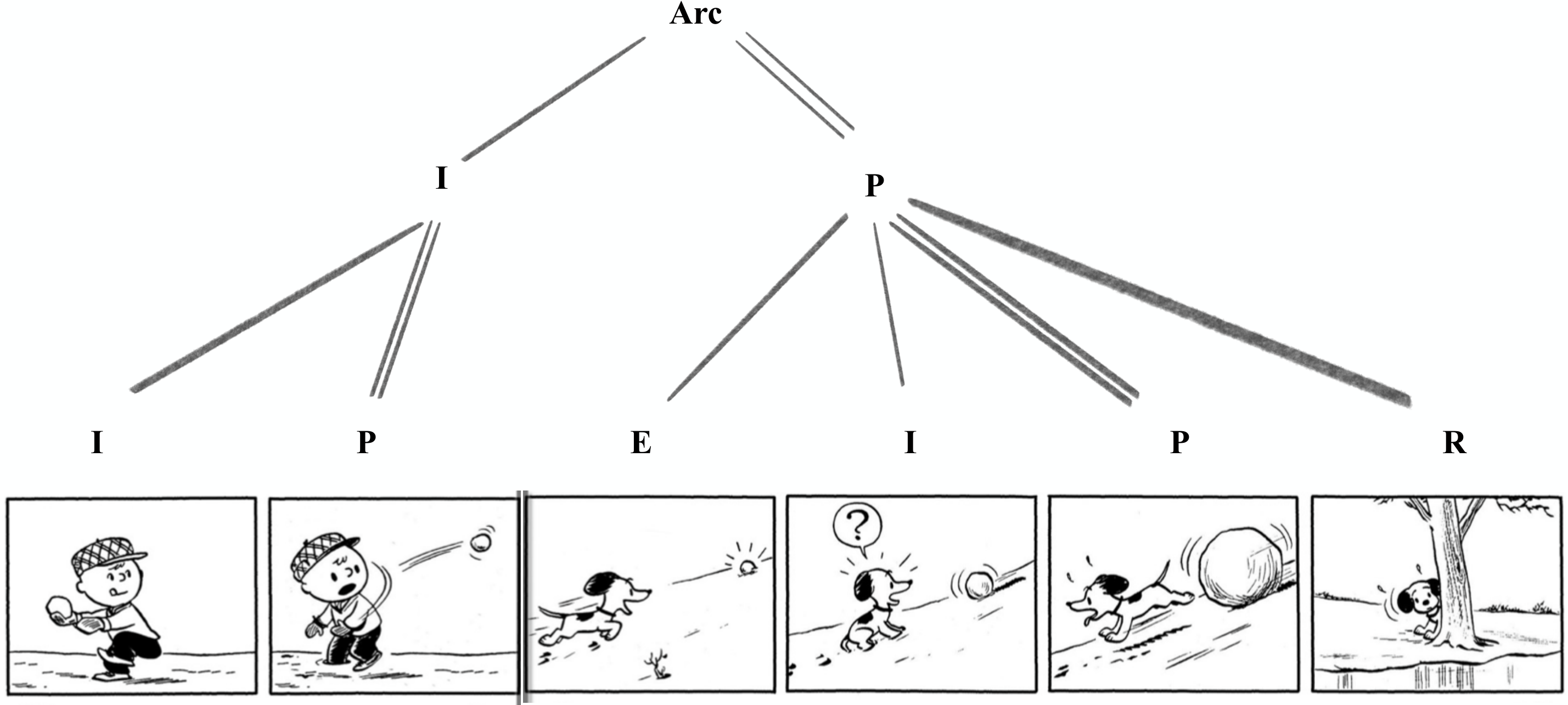
Look at the snowball strip through this lens. Charlie Brown winding up is an Initial, and the throw is a Peak. Together those two panels are the set-up for everything that follows, so as a pair they act as one Initial for the whole strip. Then Snoopy meets the snowball, an Establisher, realizes it is growing, an Initial, runs, a Peak, and hides, a Release. That group of four is the strip's main event, its Peak.
Read left to right, the panel roles run I, P, E, I, P, R. A Peak followed by an Establisher is a strange pairing. Nothing in a simple arc puts a climax right before a set-up. The tree explains why the strip still reads smoothly: the P and the E belong to different branches. The pairing looks illegal only if you ignore the hierarchy. That is the claim we set out to test. Do readers treat a strip as a flat chain of panels, or as a tree?
Where does a strip break?
The first experiment reused a simple task from an earlier study by Neil and Patrick Bender.2 Fifty-four comic readers at Tufts University were handed 120 wordless Peanuts strips, six panels each, and a pencil. For every strip they drew a line at the gap where the strip most naturally split in two and labeled it 1. Then they kept splitting until every gap between panels had a number from 1 to 5.
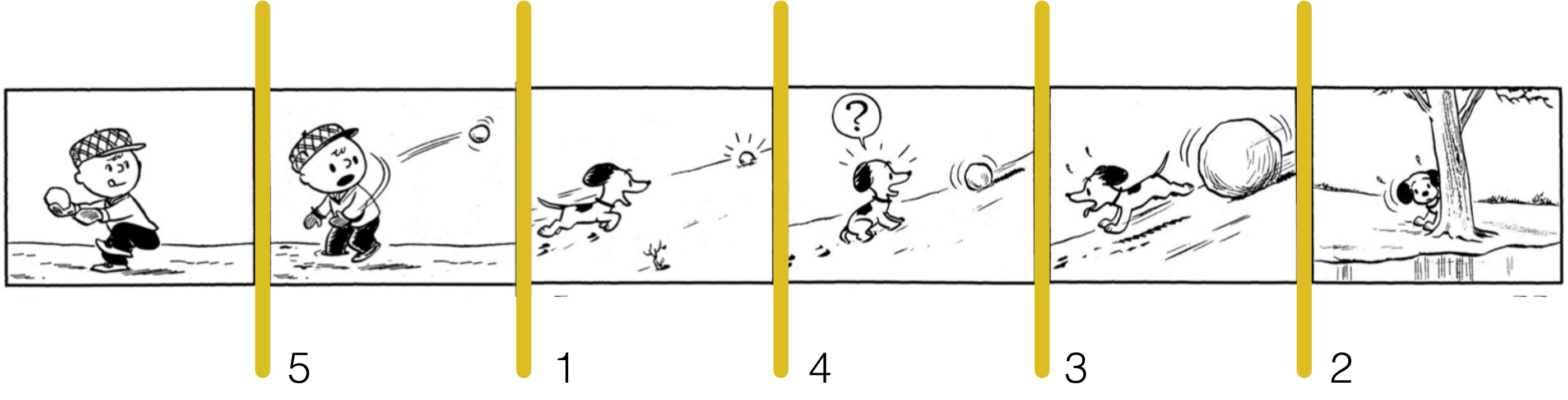
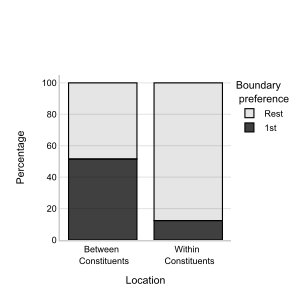
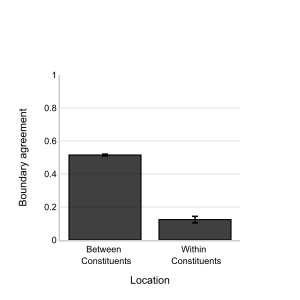
Every strip had been coded beforehand, using the grammar, as two groups of panels, so there was one theoretical boundary per strip. If readers were choosing at random among the five gaps, they would land on it one time in five. They chose it first about half the time, and any given gap elsewhere in the strip only about one time in eight, which suggests that some organizational structure is present when reading these wordless stories.
We then asked what was driving the agreement. Two kinds of things could. One is meaning: a new character walks in, the scene moves somewhere else, one thing causes another. Discourse theories of stories have long held that changes like these are what make a boundary.3 The other is the grammar: some role pairings, like a Peak followed by an Establisher, cannot sit inside the same group, so they should force a break. We coded every gap for both and asked which predicted where readers drew their first line.
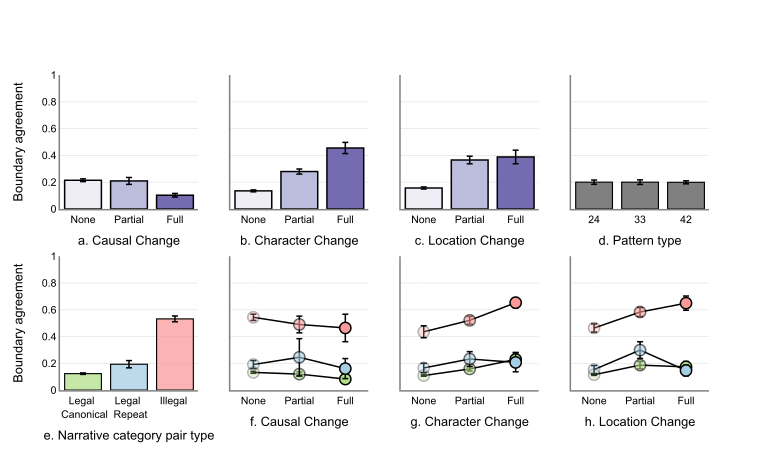
Meaning mattered. A change of characters or of location between two panels made readers more likely to split there. But the strongest single predictor was the grammar. Gaps with a forbidden pairing on either side drew far more first lines than any other kind, even after accounting for the changes in meaning. And one kind of meaning change did nothing at all. Whether one panel caused the next had no effect on where people split the strip, which was a surprise, since causation is usually treated as a backbone of stories. Readers were not aware of the grammar. They had never heard of Establishers and Peaks. Yet the categories predicted their choices.
More details about the segmentation experiment
The 120 strips were built from panels in The Complete Peanuts, volumes 1 to 9, with all text removed, and had been used in earlier studies. Each strip was coded by both authors following the diagnostic tests of visual narrative grammar into two groups of panels, with the split falling after the second, third, or fourth panel, 40 strips of each kind. Changes in characters, location, and causation between consecutive panels were coded as 0, 0.5, or 1. Boundary agreement for a gap is the fraction of the 54 readers who put their first line there. The theoretical boundary was ranked first 51.5% of the time versus 12.4% for other gaps, with agreement of 0.26 versus 0.18, t(598) = 18.1. A mixed model with gap position as a random effect explained 63% of the variance. Forbidden pairings added 0.29 to agreement, full character change 0.12, full location change 0.08. Causal change and the position of the split had no reliable effect.
Teaching a computer to read comics
Readers agree with the grammar. But that first experiment cannot tell a tree from a chain. "A Peak followed by an Establisher forces a break" is a rule about neighbors, and a flat list of allowed neighbors might do the job just as well as a nested structure. To ask about hierarchy, we needed something that could actually hold a hierarchy in its head. So we borrowed from computational linguistics.
The central idea there is surprisal. As you read a sentence word by word, a model keeps guessing what comes next. When the next word is one it expected, surprisal is low. When the word is unexpected, surprisal is high. Surprisal tracks reading times remarkably well, and it spikes at the start of a new phrase, exactly where structure changes.4 If readers of comics are doing something similar, a model that guesses the next panel should be most surprised right after a boundary. And we could score its guesses against where readers drew their lines.
We built three kinds of model, each given the same 120 strips, and they differed in what they could represent.
- An Earley parser is the kind of program that linguists use to parse sentences with a tree-shaped grammar. We handed it the visual narrative grammar as a set of tree rules, plus the meaning changes in each panel, and let it predict each panel from the ones before. It is the only model of the three that can represent nesting.
- A hidden Markov model knows the narrative roles too, but only as a chain. It learns how often an Initial is followed by a Peak, a Peak by a Release, and so on, and it pairs each role with the meaning changes that tend to come with it. No trees.
- N-gram models are the simplest possible baseline. They count how often one thing follows another, either the roles or the meaning changes but never both.
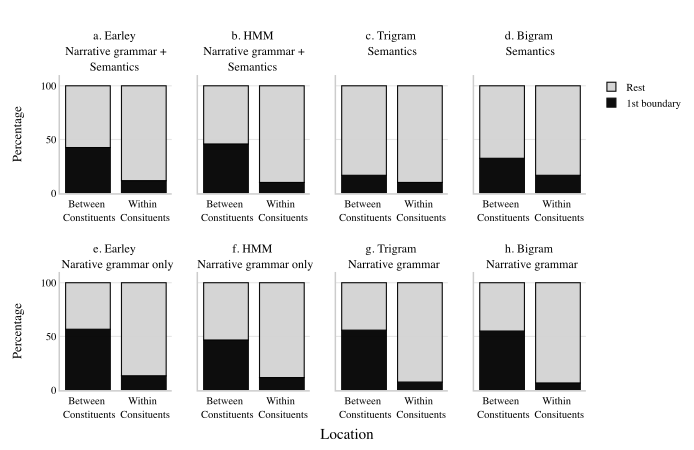
Each model was trained on nine tenths of the strips and tested on the rest, a hundred times over, and its surprisal for every panel was averaged. The panel with the highest surprisal was the model's first choice of where to split the strip.
The animation at the top of this post shows the Earley parser at work on one of the strips, building its tree one panel at a time.
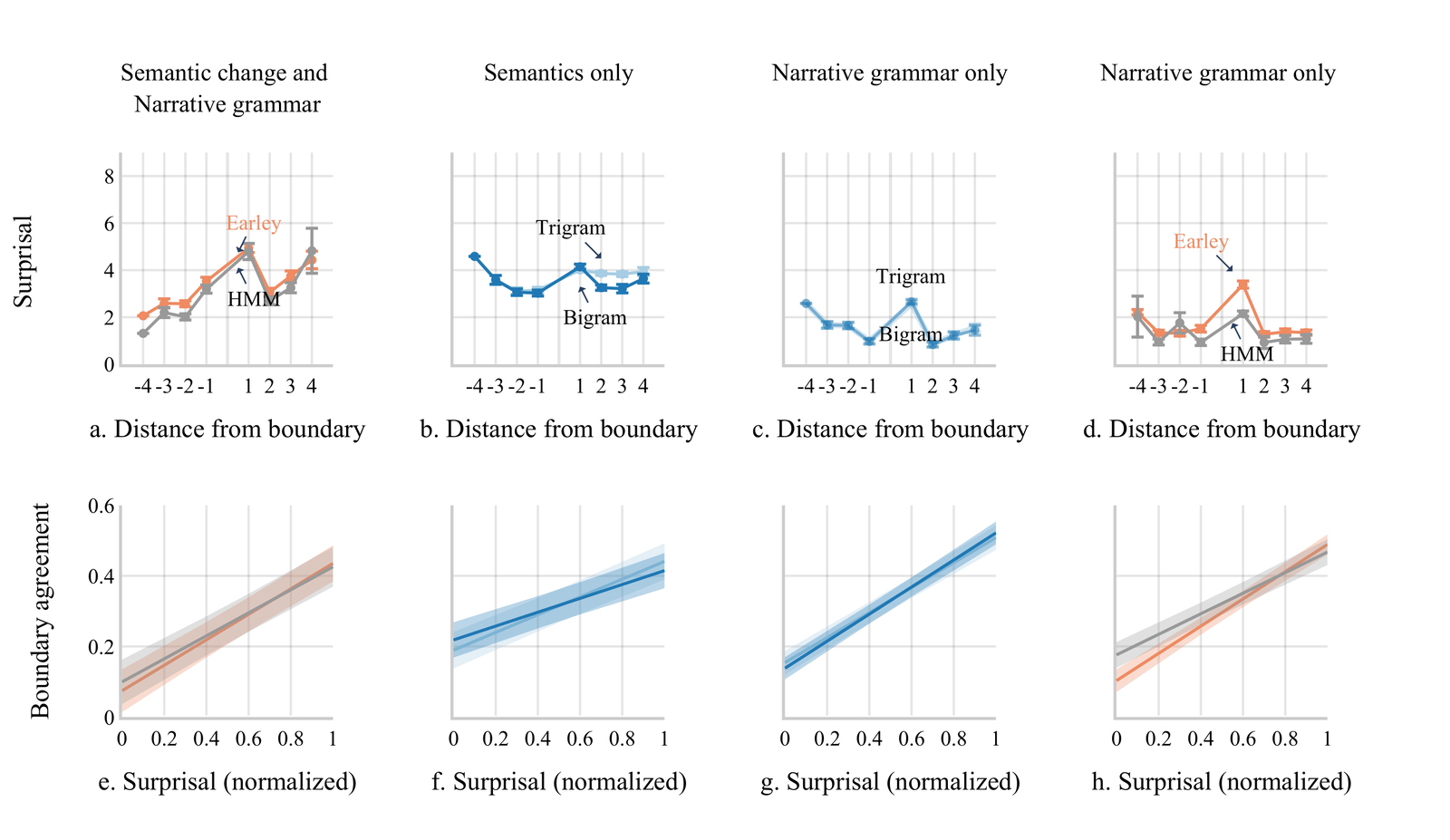
Every model's surprisal predicted where readers drew their first line, and every model was more surprised by the first panel after the boundary than by the one before it. When we ranked each model's surprisals and asked where it would split the strip, the models with the grammar behaved like people. The Earley parser picked the theoretical boundary first on 43% of strips, and 57% when it had the grammar alone, against a chance level of 20%. The model that knew only meaning, and nothing about roles, was the one that failed.
More details about the models
Surprisal for a panel is the negative log probability of that panel given the preceding panels and the model's context. The Earley parser used a probabilistic context-free grammar built from the 120 hand-coded trees, with meaning changes at the leaves, implemented in Python with NLTK. The hidden Markov model treated the narrative roles as hidden states and the meaning changes as emissions, using hmmlearn. Bigram and trigram models were fit separately to roles and to meaning changes. Each strip was held out while the models trained on a random 90% of the others, repeated 100 times. Mean surprisals: Earley with grammar and meaning 3.40 bits, HMM 3.05 bits. In mixed models predicting boundary agreement, all surprisal measures were significant; the grammar-only n-grams had the lowest AIC. Surprisal was higher after than before the boundary for every model, t(119) between 6.0 and 14.7. First-choice rates for the true boundary: Earley 42.5%, HMM 45.8%, Earley grammar-only 56.6%, HMM grammar-only 43.3%, role bigram 55%, role trigram 55.8%, meaning bigram 33.3%, meaning trigram 16.7%.
What we learned, and what we did not
The clearest result is that a grammar for pictures is real in readers' behavior. People who have never heard of narrative roles split strips where the roles say they should, and a parser that knows only those roles splits them in the same places. Meaning helps, but meaning alone is not enough, and one kind of meaning, causation, does not enter into it at all. That fits a picture in which the structure of a story and the content of a story are handled by separate systems working side by side, a claim Neil's earlier brain-recording work had pointed toward.5
All three kinds of model fit the task. On six-panel strips, a parser with a tree, a Markov model with a chain, and even a plain count of which role follows which all predicted where readers split the strip. But fitting this task is not the same as being a theory of how people read, and each model has shortcomings that the task was too small to expose. An n-gram model only ever looks back one or two panels. It has no way to represent a connection between the first panel of a strip and the fifth, so in a longer narrative, where the payoff of a set-up may arrive many panels later, it has nothing to say. It has a deeper problem too. Theories of visual narrative comprehension hold that the grammar and the meaning are processed side by side, as two parallel streams, and there is brain-recording evidence for that separation.6 Modeling the two in parallel means tracking how one role leads to the next and, at the same time, how each role tends to go with particular changes in meaning. An n-gram can count one of those or the other, never both at once. That is why we treated the n-grams as a baseline rather than a candidate theory, and why the discussion in the paper rests on the parser and the Markov model, which can hold both streams.
The Markov model can carry more, but it is still a chain: each panel is predicted from the previous state alone, and a relationship that skips over intervening panels has to be smuggled in through the states. Intuitively, the tree looks like the structure built for the job. It represents a long-distance dependency directly, as one branch spanning a whole group of panels, and it should pull ahead as dependencies get longer. But intuition is not evidence. Given enough data, a Markov model can pick up surprisingly rich statistical regularities, and it is entirely possible that a chain armed with those regularities would do the trick just as well. Who knows. That is why the question needs longer strips and richer datasets rather than an argument.
It is also not a new question. The same argument has run through linguistics for years. One camp holds that sentence comprehension is fundamentally hierarchical, that structures, not strings, are what the mind builds.7 Another argues that much of everyday language use can be explained by sequential, chain-like statistics, with hierarchy invoked only when it is needed.8 The models in this study are the visual-narrative versions of those two positions, and the tools for telling them apart are the same tools.
To my knowledge this is the first study to draw that distinction for visual narratives and to build the framework in which it can be tested. What it establishes is that the question is now answerable. Readers behave as if there is a grammar, computational models carrying that grammar behave like readers, and the models disagree with one another in principled ways that longer sequences and richer datasets will expose. That is what I hope to do next: take the same framework to strips with many more panels, with stories nested inside stories, and see whether the tree earns its keep.
There is a thread here that runs through the other posts on this blog. In the film post, the brain bridged gaps by predicting what should come next. Surprisal is that same idea made precise: a number for how badly the prediction failed. In comics, the predictions come from a grammar. When a panel arrives that the grammar did not expect, the story breaks there, for a parser and for a person alike.
Upadhyayula & Cohn (2025). A computational framework to study hierarchical processing in visual narratives. Cognitive Science, 49(5), e70050. Paper · Data & code · Talk
This work in the research section: Does visual narrative comprehension involve a grammar?
Figure credits. The opening animation is by the author. Figures 1, 2, 4, 5, 8, and 10 are reproduced from Upadhyayula & Cohn (2025), Cognitive Science, doi:10.1111/cogs.70050, published under a CC BY-NC-ND 4.0 license. The Peanuts panels in Figures 1 and 2 are © Peanuts Worldwide LLC and appear as they do in the article. The headshot is the staff portrait from Tilburg University.
-
Cohn (2013), Visual narrative structure, Cognitive Science, doi:10.1111/cogs.12016. For the deeper background on stories having a structure, see Mandler & Johnson (1977), Remembrance of things parsed: Story structure and recall, Cognitive Psychology, doi:10.1016/0010-0285(77)90006-8. ↩
-
Cohn & Bender (2017), Drawing the line between constituent structure and coherence relations in visual narratives, Journal of Experimental Psychology: Learning, Memory, and Cognition, doi:10.1037/xlm0000290. ↩
-
Zwaan & Radvansky (1998), Situation models in language comprehension and memory, Psychological Bulletin, doi:10.1037/0033-2909.123.2.162. ↩
-
Hale (2001), A probabilistic Earley parser as a psycholinguistic model, Proceedings of NAACL, doi:10.3115/1073336.1073357; Levy (2008), Expectation-based syntactic comprehension, Cognition, doi:10.1016/j.cognition.2007.05.006. ↩
-
Cohn, Jackendoff, Holcomb & Kuperberg (2014), The grammar of visual narrative: Neural evidence for constituent structure in sequential image comprehension, Neuropsychologia, doi:10.1016/j.neuropsychologia.2014.09.018. ↩
-
For the theories, see Cohn (2020), Your brain on comics: A cognitive model of visual narrative comprehension, Topics in Cognitive Science, doi:10.1111/tops.12421, and Loschky, Larson, Smith & Magliano (2020), The Scene Perception & Event Comprehension Theory (SPECT) applied to visual narratives, Topics in Cognitive Science, doi:10.1111/tops.12455. For the brain evidence, see Cohn, Paczynski, Jackendoff, Holcomb & Kuperberg (2012), (Pea)nuts and bolts of visual narrative: Structure and meaning in sequential image comprehension, Cognitive Psychology, doi:10.1016/j.cogpsych.2012.01.003, which found that the brain's response to meaning was blind to the presence of narrative structure, and the earlier footnote on Cohn and colleagues (2014). ↩
-
Everaert, Huybregts, Chomsky, Berwick & Bolhuis (2015), Structures, not strings: Linguistics as part of the cognitive sciences, Trends in Cognitive Sciences, doi:10.1016/j.tics.2015.09.008. ↩
-
Frank, Bod & Christiansen (2012), How hierarchical is language use?, Proceedings of the Royal Society B, doi:10.1098/rspb.2012.1741. ↩