Why you miss it when a movie skips
Jump a film a full second forward during an eye movement and most people never notice. Jump it backward and they notice more often. Two studies on how vision papers over gaps in time, and why the direction matters.
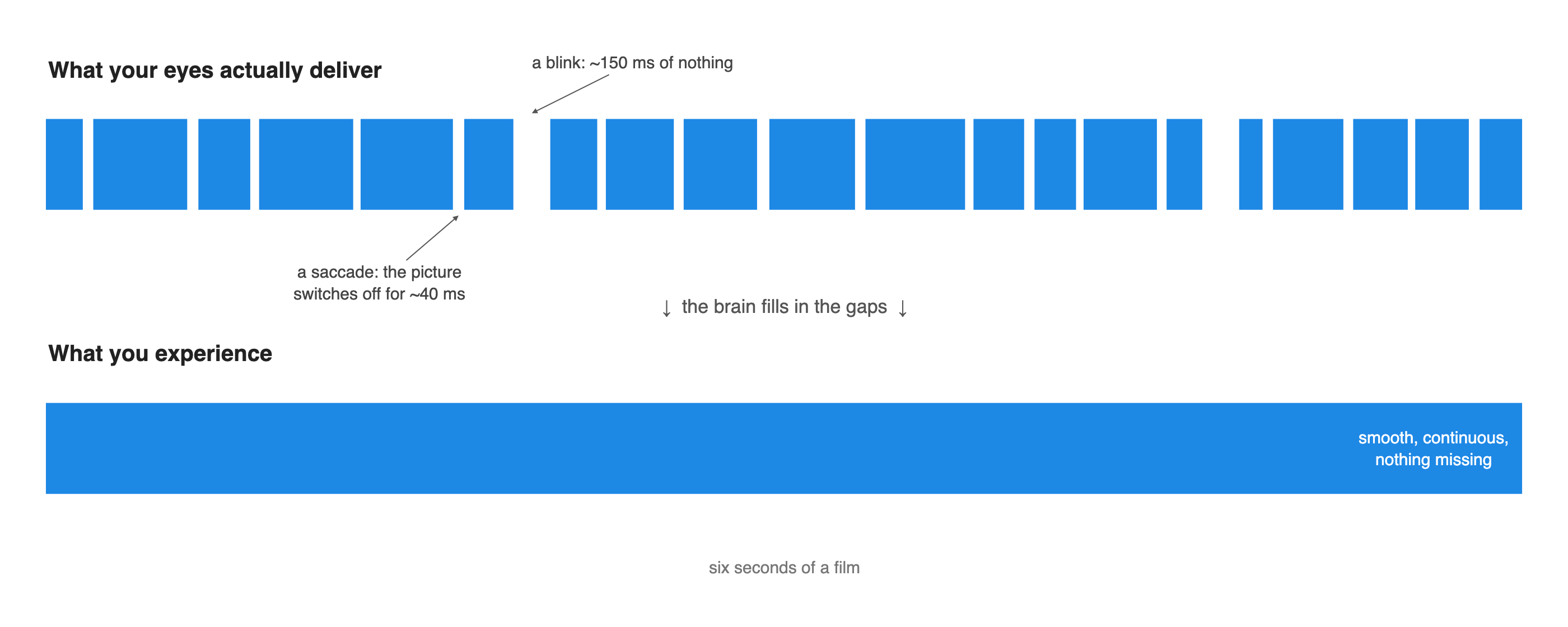
Our visual system is a marvel with some embarrassing flaws. If you have read my earlier posts on tracking moving objects and on the perception of now, you already know this to be true. The resolution of the retina is anything but uniform: only the fovea, a pinhead of a spot at the center of your gaze, sees sharply, and everything out in the periphery is a smear. To top that off, we cannot even sample the world continuously. We blink, thousands of times a day. And to make up for the poor resolution out in the periphery, we fling our eyes around several times a second in rapid jumps called saccades. Here is the strange part. During every one of those saccades the visual system is effectively paralyzed. Processing shuts down, and for a few tens of milliseconds nothing useful gets through, a phenomenon called saccadic suppression that has been studied for half a century.1 Why would a visual system blink or move so rapidly if it goes blind each time? One school of thought is that these brief blackouts are not wasted. They give the eye and the brain a moment to reset and prepare for the next movement.2 Add it all up and what the eye actually delivers is a patchy, stuttering, half-blind signal. So how on earth do we end up with such a rich visual experience?
Think about the last movie you watched. It felt rich, immersive, and continuous. At no point did you feel your eyes blinking, or notice the picture cutting out because you had to move them. That is because the brain is pulling another one of its tricks. It is constantly, silently filling in the missing information, and it does it so well that you never feel the seams. Which raises a question worth an experiment: if the brain is patching the picture all the time, how big a hole could you cut in a movie before anyone noticed?
What could the brain be doing?
There are a few ways to build continuity out of an interrupted signal.
The simplest version is a camera: compare each new snapshot to the last and flag any difference. If that were how it worked, any change during a gap would jump out at you. It does not. In a famous study, an experimenter asking a stranger for directions was swapped for a different person while two workers carried a door between them, and half the strangers carried on as if nothing had happened.3 Film editors rely on the same blindness, since viewers routinely fail to notice cuts that follow the rules of continuity editing.4
An alternative hypothesis is that the brain is a prediction engine. It does not wait for the next moment to arrive and then look at it. It is constantly generating expectations about what is coming next, and it uses the input mainly to check those expectations. This is the heart of Jeff Zacks's event segmentation theory. As you watch something unfold, your brain keeps a running picture of what is going on and uses it to guess what comes next. Most of the time the guess is right, and the world simply confirms it. The brain only has to sit up and take notice when the guess turns out to be wrong.5
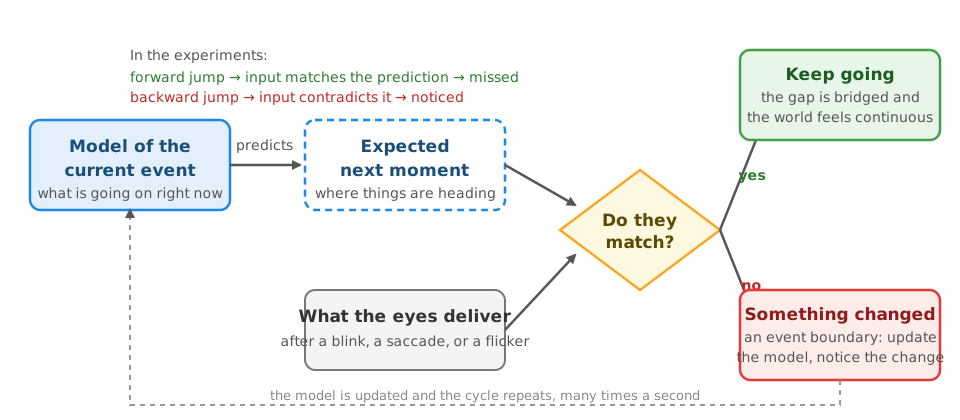
If that is how the brain bridges its own blackouts, it makes a specific prediction about what you should miss. A gap that lands where the world was going anyway should slip through, because the input matches the expectation. A gap that puts the world somewhere it was not heading should stand out, because the expectation fails. Cuts cannot test this, since they are designed to be invisible and land at moments an editor chose. We needed disruptions with no editor helping, in the middle of a shot, that could run either with the flow of the event or against it.
Jumping a film during an eye movement
For the first study, with John Henderson at the University of California, Davis, we used the film 1917. It was shot to look like one continuous take, so there are no cuts to hide behind. We took 37 one-minute clips, stripped the sound, and had people watch them while an eye tracker followed their gaze. Their only job was to press a button whenever the film seemed to jump.

Center for Mind and Brain, UC Davis
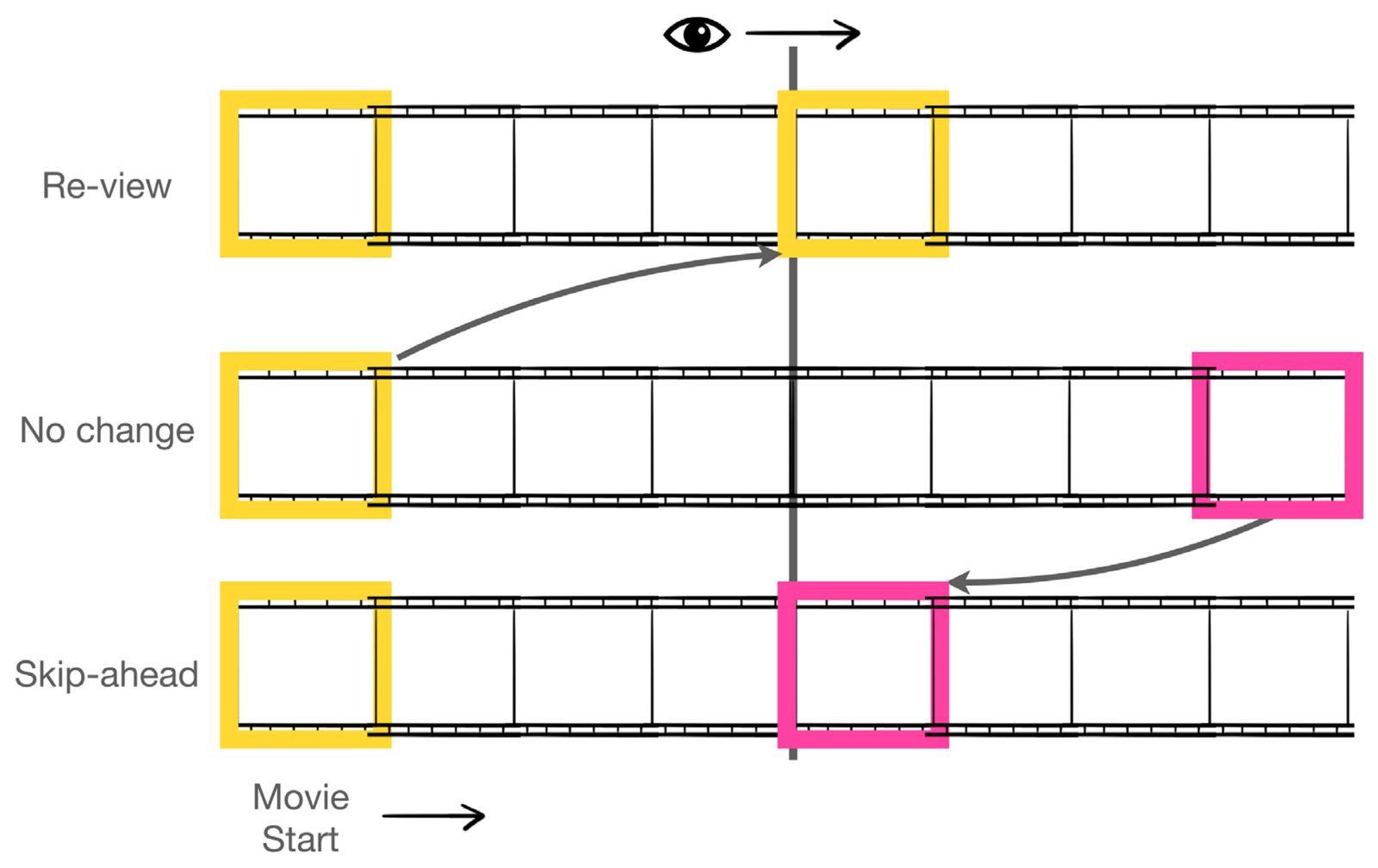
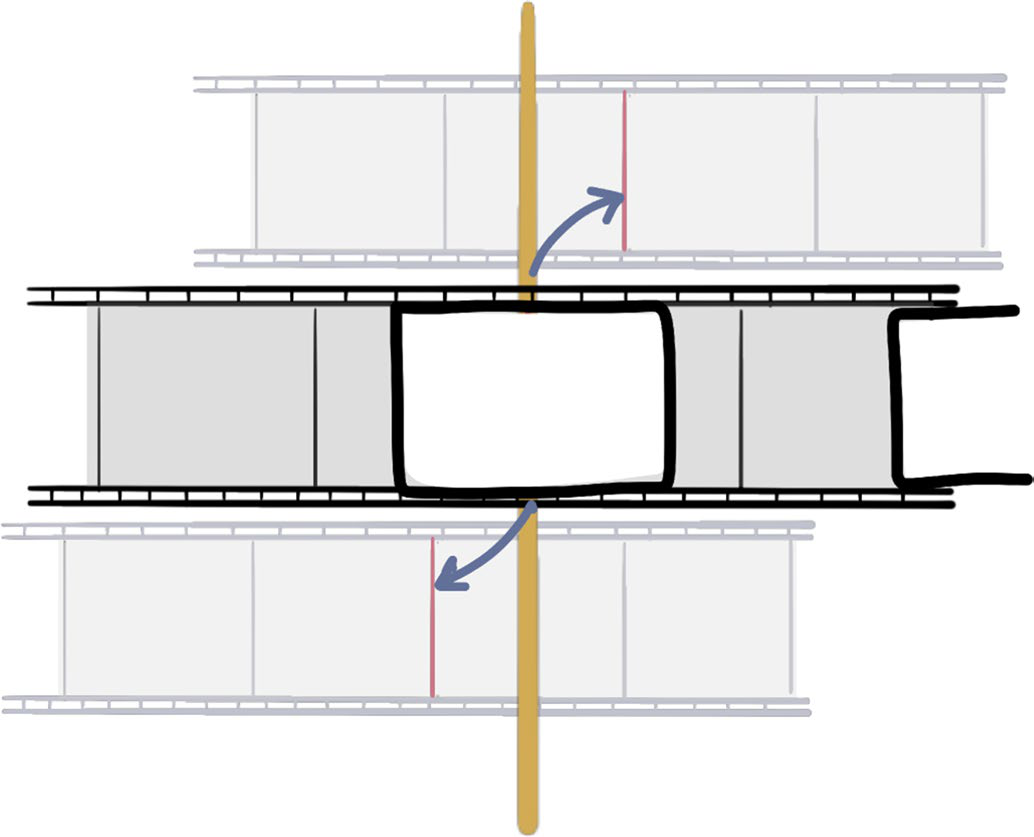
The trick was in the timing. Every few seconds the program waited for a saccade and switched the video during it, inside the window when vision is suppressed, so the switch itself was invisible. What changed was where in time the clip was. Sometimes it jumped ahead, skipping content the viewer had not yet seen. Sometimes it jumped back by the same amount, replaying content they had just watched. And sometimes it "switched" to the same moment, which told us how often people pressed the button when nothing had happened. A forward jump runs with the flow of the event, so a prediction engine should let it through. A backward jump throws the event into reverse, which no prediction anticipates, so it should stand out.
Two things stood out. First, people missed a lot. Even though they knew the jumps were coming and were watching for them, they failed to report about a quarter of the jumps in the first experiment. False alarms were almost nonexistent, so these were real misses. Second, the direction mattered. Forward skips were missed about ten percent more often than backward ones, at every size we tested.
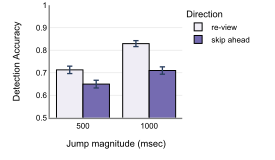
A second experiment doubled the jumps to one and two seconds. Two seconds is a long time in a film. A character can cross a room in two seconds. People still missed jumps of that size, roughly one in four forward jumps of two full seconds went unreported, and the gap between forward and backward grew rather than shrank.
More details about the eye tracking experiments
Thirty participants in Experiment 1 and 29 in Experiment 2 each watched 35 clips. Three versions of every clip played in parallel, one unaltered and two starting 500 and 1,000 ms later (1,000 and 2,000 ms in Experiment 2), with only one visible. When eye velocity exceeded 140 degrees per second, the display switched to another version, on average 8.5 ms after the saccade began, well inside the 30 to 40 ms a saccade lasts. Each clip contained one jump of each direction and size plus a 0 ms control. A press within 2 s counted as a detection. Detection was 67% for skip-ahead and 77% for re-view in Experiment 1, and 73% versus 89% in Experiment 2, with false alarms of 0.2% and 0.3%. Direction, magnitude, and their interaction were all significant in mixed-effects models; saccade duration was not.
Why forward jumps hide better
If prediction is what hides forward jumps, then a forward jump should hide best when what arrives after it looks most like what was expected. To test that, we looked at the video itself. Optic flow is the pattern of motion across the image from one frame to the next, the thing that tells you the camera is panning left or a soldier is running toward you. We computed the flow just before and just after every jump and asked how similar the two were.
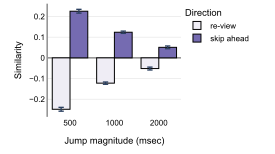
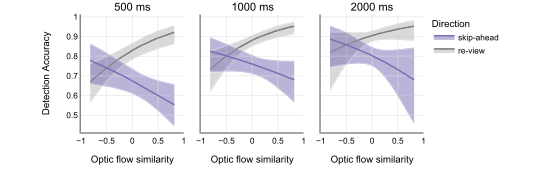
The result had a clean shape. Forward jumps left the motion pattern much as it was, since a pan or a run continues in the same direction. Backward jumps reversed it. And for forward jumps, the more similar the motion before and after, the more often people missed the jump. When the world arrives looking the way you expected it to look, you do not notice that you skipped the part in between. Something is being predicted.
Taking the eyes out of it
There was a loose end. Every jump in the first study happened during a saccade the viewer chose to make, and eye movements are not random. A viewer who gets bored, or who looks away from the action, might be exactly the viewer who misses a jump. Perhaps the result was about the eyes rather than about the visual system bridging gaps in general.
So in the second paper we removed the eyes from the design. We ran the study online with no eye tracker. Instead, every two seconds the screen went white for 150 milliseconds, a flicker, and during some flickers the film jumped forward or backward. The timing was set by us, not by the viewer, and everyone saw the jumps at the same moments. If the bridging is something the visual system does whenever its input is interrupted, the same pattern should appear with a flicker as with a saccade.
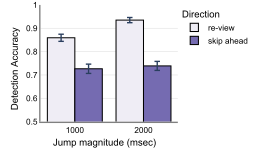
It did, and the numbers got worse. People now caught only about half of the jumps. Forward jumps were again missed more than backward ones, by ten points in the first experiment and seventeen in the second, and the difference again survived jumps of two full seconds. Whatever is filling the gaps does not care whether the gap came from an eye movement or from a blank screen. It is the visual system intelligently bridging an interruption with what it expects to see next.
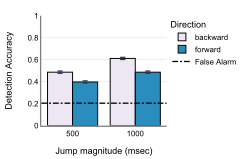
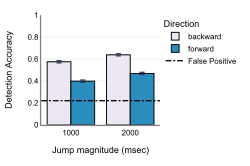
More details about the flicker experiments
Sixty-six participants in each experiment did the task in a browser, built in jsPsych, with the same 1917 clips scaled to 463 by 240 pixels. A white mask covered the video for 150 ms every 2,000 ms. Jumps of 500 or 1,000 ms (Experiment 1) or 1,000 or 2,000 ms (Experiment 2) occurred during some flickers, 4 to 6 s apart, with a 0 ms control. A press within 1.75 s counted. Detection was 44% forward versus 54% backward in Experiment 1, and 43% versus 60% in Experiment 2. Larger jumps were easier in both. False alarms ran about 21%, giving a d′ of 0.43. Curiously, this is the reverse of an earlier finding that luminance changes are easier to catch across flickers than across saccades,6 which suggests jump detection leans on higher-level information than a change in brightness does.
Try it yourself
Below is the actual experiment, trimmed to two one-minute clips, and most people are surprised by how many jumps get past them. The film footage is copyrighted, so the clips here come from the META stimulus set, a library of everyday activities filmed in Jeff Zacks's lab for studying event cognition.7
The takeaway
The continuity you experience when you watch a film is not in the film. It is built, and the builder is a prediction engine. It carries forward where the event was heading, which is why forward jumps slip through when the world arrives looking roughly as predicted, and why backward jumps, which run the event in reverse, get caught. That is not a defect. It is the same machinery that hides every blink and every saccade of your day, and it is working whether the interruption comes from your own eyes or from a flickering screen.
When the second paper came out, the Psychonomic Society chose it for a feature by Melinh Lai, who opened by confessing a lifetime of being accused of laziness "when really I've been hard at work watching TV and movies." Lai's closing line is the one I would want you to walk away with: "lying around watching TV isn't a waste. Our visual systems are hard at work." So the next time you feel lazy for watching a movie, think about how much intelligent work your brain is doing to make it look continuous.8
Upadhyayula & Henderson (2023). Spatiotemporal jump detection during continuous film viewing. Journal of Vision. Paper · Data & materials
Upadhyayula & Henderson (2024). Spatiotemporal jump detection during continuous film viewing: Insights from a flicker paradigm. Attention, Perception & Psychophysics. Paper · Data & materials · Psychonomic Society feature
This work in the research section: Predictive constraints on vision
Figure credits. The opening timeline, the saccade-contingent schematic, and the prediction engine diagram are by the author. Figures 2, 5, 8, and 9 are reproduced from Upadhyayula & Henderson (2023), Journal of Vision, doi:10.1167/jov.23.2.13, published under a CC BY 4.0 license. Figures 1, 2, and 4 are reproduced from Upadhyayula & Henderson (2024), Attention, Perception & Psychophysics, doi:10.3758/s13414-023-02837-8, © The Psychonomic Society. The demo clips are from the META stimulus set (Bezdek et al., 2022). Quotations are from Melinh K. Lai's Psychonomic Society feature, linked above. The headshot is the faculty portrait from the UC Davis Center for Mind and Brain.
-
Matin (1974), Saccadic suppression: A review and an analysis, Psychological Bulletin, doi:10.1037/h0037368; Burr, Morrone & Ross (1994), Selective suppression of the magnocellular visual pathway during saccadic eye movements, Nature, doi:10.1038/371511a0; Ross, Morrone, Goldberg & Burr (2001), Changes in visual perception at the time of saccades, Trends in Neurosciences, doi:10.1016/S0166-2236(00)01685-4. For what eye movements do for reading and scene viewing, see Rayner (1998), Eye movements in reading and information processing: 20 years of research, Psychological Bulletin, doi:10.1037/0033-2909.124.3.372, and Henderson & Hollingworth (2003), Global transsaccadic change blindness during scene perception, Psychological Science, doi:10.1111/1467-9280.02459. ↩
-
Nakano, Kato, Morito, Itoi & Kitazawa (2013), Blink-related momentary activation of the default mode network while viewing videos, Proceedings of the National Academy of Sciences, doi:10.1073/pnas.1214804110. ↩
-
Simons & Levin (1998), Failure to detect changes to people during a real-world interaction, Psychonomic Bulletin & Review, doi:10.3758/BF03208840. ↩
-
Smith & Henderson (2008), Edit blindness: The relationship between attention and global change blindness in dynamic scenes, Journal of Eye Movement Research, doi:10.16910/jemr.2.2.6. On what continuity editing does to event perception, see Magliano & Zacks (2011), The impact of continuity editing in narrative film on event segmentation, Cognitive Science, doi:10.1111/j.1551-6709.2011.01202.x. ↩
-
Zacks, Speer, Swallow, Braver & Reynolds (2007), Event perception: A mind-brain perspective, Psychological Bulletin, doi:10.1037/0033-2909.133.2.273. ↩
-
Henderson, Brockmole & Gajewski (2008), Differential detection of global luminance and contrast changes across saccades and flickers during active scene perception, Vision Research, doi:10.1016/j.visres.2007.10.008. ↩
-
Bezdek, Nguyen, Hall, Braver, Bobick & Zacks (2022), The multi-angle extended three-dimensional activities (META) stimulus set: A tool for studying event cognition, Behavior Research Methods, doi:10.3758/s13428-022-01980-8. ↩
-
Lai, M. K. (2024, April 3). Now you don't see me, and now you still don't see me: Detecting movie skips using a flicker paradigm. Psychonomic Society Featured Content. ↩